15-Inch vs 18-Inch Speaker: Which Size Is Right for Your Sound System?
21 Sep 2026
Drivers fail in six ways: thermal, mechanical, adhesive, suspension fatigue, environmental and — rarely — manufacturing. Measure the DC resistance across the terminals first. An open circuit or near-zero reading means the voice coil has gone, which is thermal. A correct reading with bad sound means something mechanical. Five of the six causes are about how the driver was used, and the most common single cause is an amplifier too small for the job being pushed into clipping.
We get these calls on Monday mornings. Something died at the weekend, there is another booking on Friday, and the question is always the same two: what happened, and will it happen again.
The honest version of the answer is not always comfortable. Manufacturing defects exist, and when a driver fails in its first weeks with no abuse we replace it. But that is a small minority of what we see. Most failed drivers were killed by something in the system around them, and the useful part of this article is working out which.
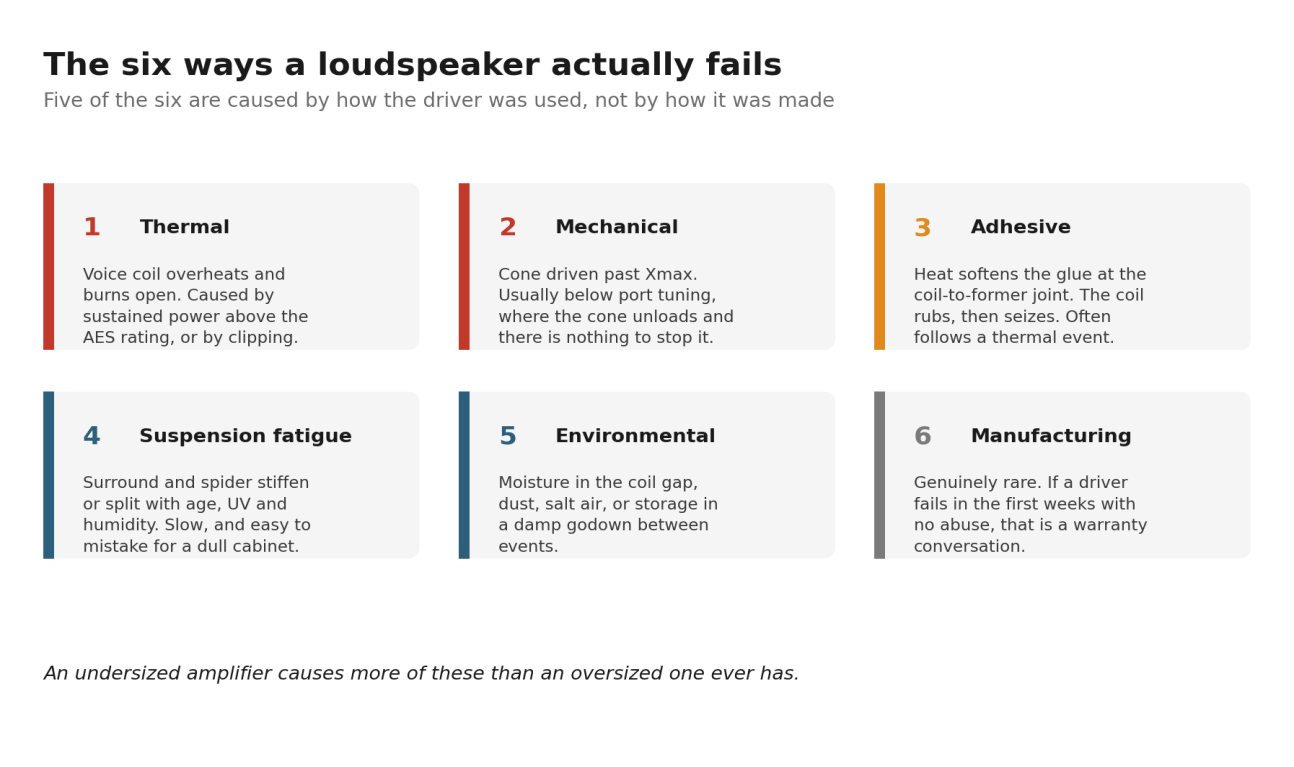
The most common failure by a wide margin. The voice coil is a few metres of fine wire sitting in a narrow magnetic gap, and almost all the electrical energy you send it becomes heat rather than sound. A professional driver is only a few per cent efficient — the other ninety-plus per cent is warming that coil.
Push enough sustained power in and the enamel insulation on the wire breaks down, adjacent turns short together, and eventually the wire opens. You will often smell it before you hear it. Take the driver out and the former is blackened or the winding has visibly unravelled.
What causes it: running above the AES rating for extended periods; poor ventilation in a sealed-up cabinet on a hot night; and, most often, an amplifier that is too small being driven into clipping.
This deserves its own section because it is counter-intuitive and it is the single thing most worth changing.
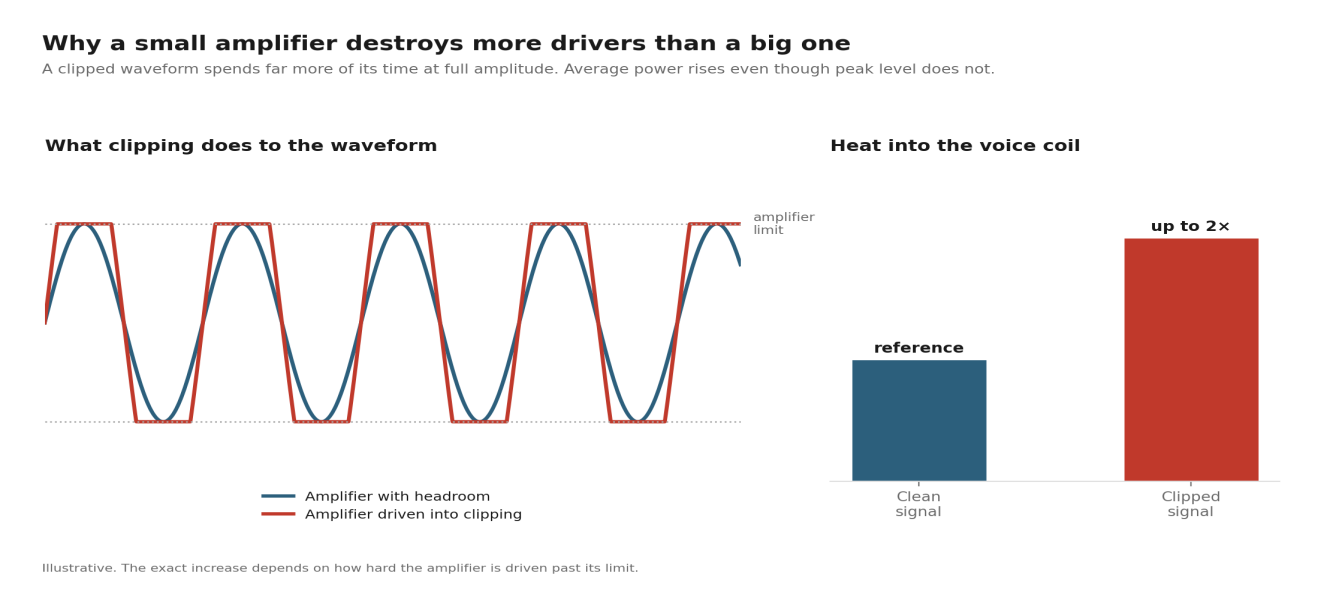
An amplifier that runs out of voltage cannot make the waveform any taller, so it flattens the tops. The result spends far more of its time at full amplitude than the music ever did. Peak level has not changed at all — but average power, which is what heats the coil, can roughly double.
There is a second problem. Flattening a waveform generates harmonics that were not in the original signal, and those harmonics land in the high frequencies. In a full-range system, a clipping amplifier sends energy into the compression driver that the crossover never expected. It is common to lose the HF unit and the bass driver in the same evening from one undersized amplifier.
The fix is the opposite of what most people assume. Use an amplifier rated at roughly twice the driver's AES figure, which is approximately its program power number, and set the limiter properly. A large amplifier used sensibly is far safer than a small one being flogged. There is more on sizing in How Many Speakers Do You Need for a Live Event?
Xmax is the distance the coil can travel while staying in the linear part of the magnetic gap. Push past it and the driver distorts. Push far past it and the coil former strikes the back plate, the spider tears, or the lead-out wires snap.
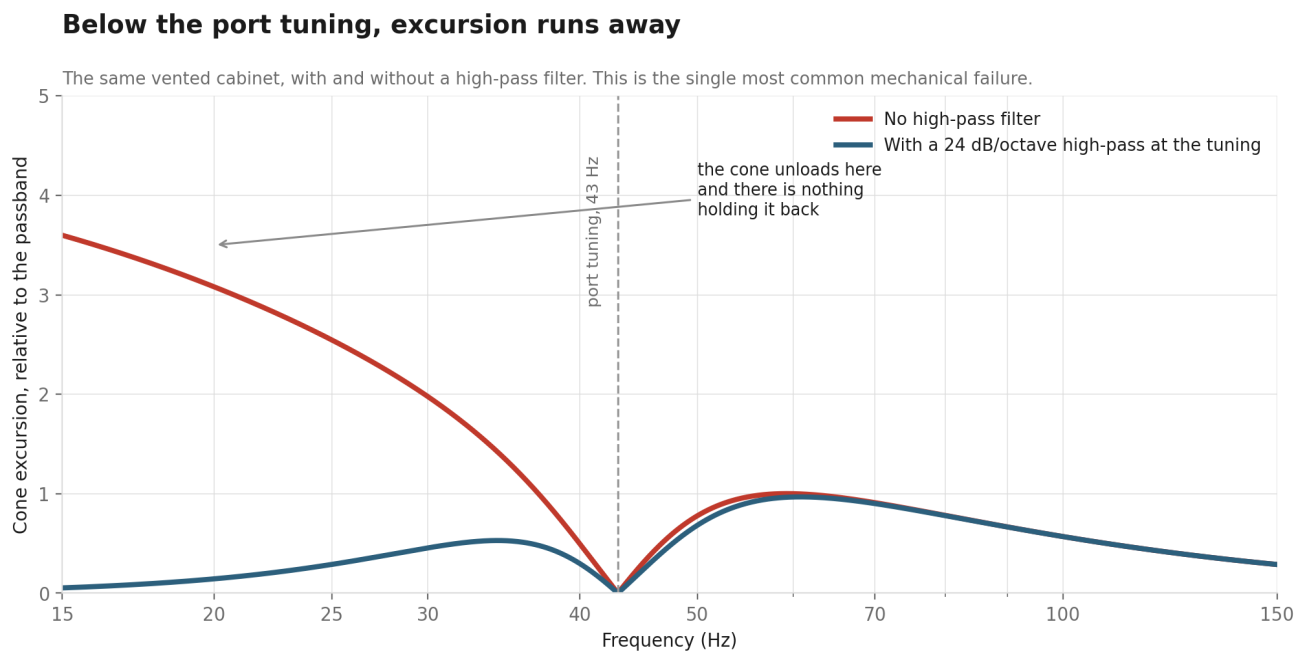
Almost all of it happens in one specific place: below the port tuning frequency of a vented cabinet. Above tuning, the port loads the driver and the cone barely moves. Below it, the port stops working and there is nothing restraining the cone — at exactly the frequencies where it is producing no useful output anyway.
A 24 dB per octave high-pass filter at or just below the tuning frequency prevents this completely. Every vented subwoofer needs one. If you are building your own cabinets, the enclosure design guide covers where to set it and why.
The voice coil is bonded to its former, and the former to the cone. Those joints have a temperature limit. Run the coil hot enough for long enough and the adhesive softens; the coil shifts fractionally out of alignment and begins to rub against the pole piece. You hear it first as a scratching under bass notes, then it seizes.
This is usually a consequence of a thermal event rather than a separate cause. A driver that survived one very hard night and now rubs quietly has often had its glue joint softened. It will not recover, and it will get worse.
Surrounds and spiders age. Heat, ultraviolet light, humidity and simple mechanical cycling all stiffen or embrittle them over years. Resonance frequency creeps up, bass output falls off, and the driver quietly stops doing what it did when it was new.
It is easy to miss because nothing fails. The system just gradually sounds less impressive, and most people blame the room, the amplifier or the music before they suspect the drivers. In a rental inventory it is worth measuring a sample of the fleet once a year rather than waiting for a complaint.
The magnetic gap on a professional driver is a fraction of a millimetre wide. Anything that gets into it stays there.
Moisture. Humidity in an unheated godown, condensation from a cold van into a warm hall, rain on an uncovered outdoor stack. Corrosion in the gap causes rubbing that no amount of drying out reverses.
Dust and grit. Common on construction-adjacent installs and open-ground events. Gets in through the vent and stays.
Storage. Cabinets stacked face-down on a concrete floor, or left in a vehicle through a hot afternoon, age faster than cabinets stored upright somewhere dry.
Manufacturing defects are real and they are rare. A driver that fails in the first few weeks, at normal levels, with a correctly sized amplifier and a filter in place, is a warranty conversation and not an argument. Keep the driver, keep the serial, and tell us what the system was.
The reason we can be confident this category is small is that every unit is quality-control tested before dispatch and the parameters are measured rather than assumed. That does not make defects impossible. It makes them uncommon enough that the diagnosis below is worth doing first.
Two minutes, a multimeter and your hands will tell you most of it. Disconnect the driver from the amplifier before you start.
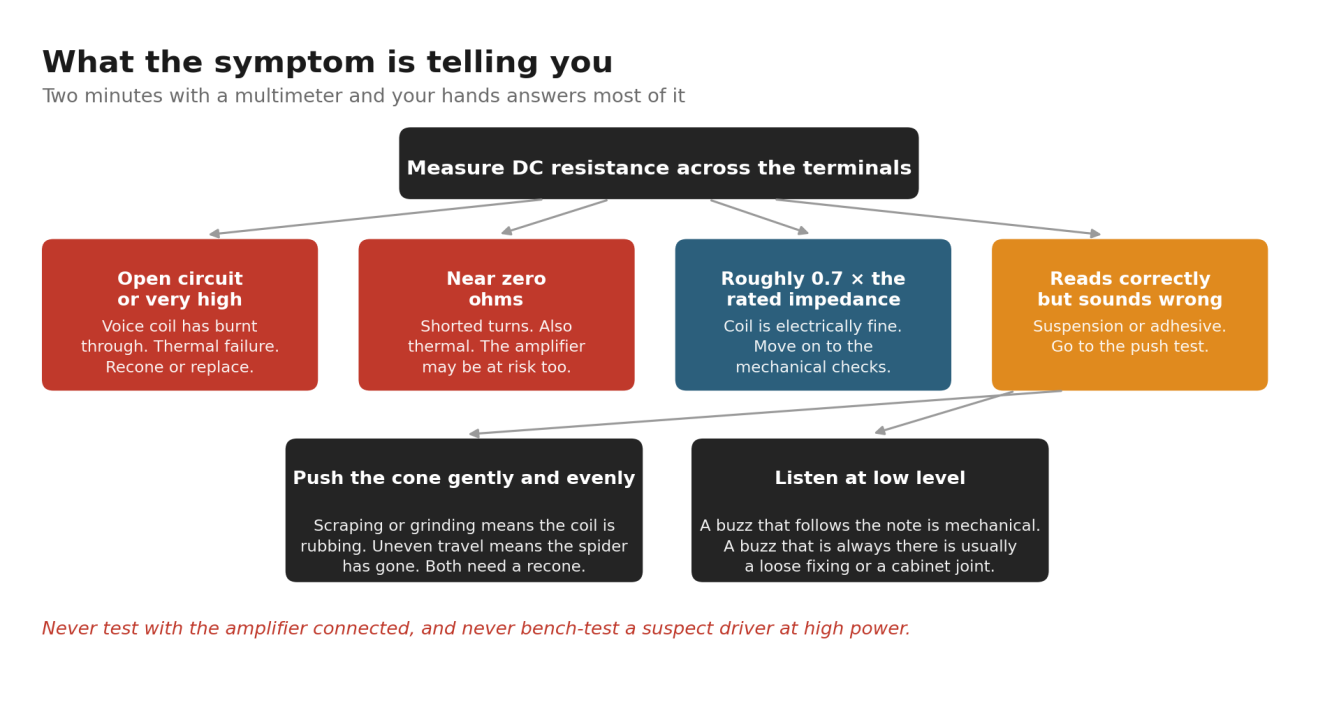
The DC resistance of a healthy driver reads roughly seventy per cent of its nominal impedance — so about 5.5 to 6.5 ohms on an 8-ohm driver, and 2.8 to 3.4 on a 4-ohm one. An open circuit or a reading close to zero means the coil has gone.
If the resistance is right, push the cone in gently and evenly with your fingers spread around the dust cap. It should move smoothly and silently. Scraping or grinding means the coil is rubbing. A cone that tilts or moves unevenly means the spider has failed.
One caution: never bench-test a suspect driver at high power to see if it still works. If the coil is partly damaged you will finish it off, and you will lose the evidence of what actually happened.
Once the diagnosis is done the commercial question is straightforward.
A burnt coil in an otherwise sound driver — cone, surround and spider intact, frame true — is a recone candidate. The expensive parts are the magnet assembly and the frame, and both survive a thermal failure.
A driver with a torn spider, a damaged frame, or corrosion in the gap is usually a replacement. A recone on a compromised motor gives you the same failure again.
Suspension fatigue across a whole fleet is a replacement decision, not a repair one. If half the inventory has aged, reconing half of it costs more than it returns.
Whichever way it goes, work out what caused it first. Reconing a driver and putting it straight back behind the same undersized amplifier gets you a second identical failure and a bill for both.
For help with a driver issue or replacement, send us the model, what the multimeter read, the amplifier and cabinet setup, filter settings, and what was playing when it failed.
Use the product enquiry form or contact us on WhatsApp at +91 70444 11800.
For replacements, the professional loudspeaker range publishes full specifications including AES power on every model, and the test standard page sets out how those figures were measured.
Most often a
voice coil overheated, usually because the amplifier was too small and was
driven into clipping. Measure the DC resistance across the terminals to
confirm.



No comments
No comment available for this blog. Be the first to leave a comment!